Does polarity inversion affect MIDI conversion?
Not in this controlled eight-note fixture. The normal and fully inverted waveforms both retained all eight notes with zero median misses and extra events.
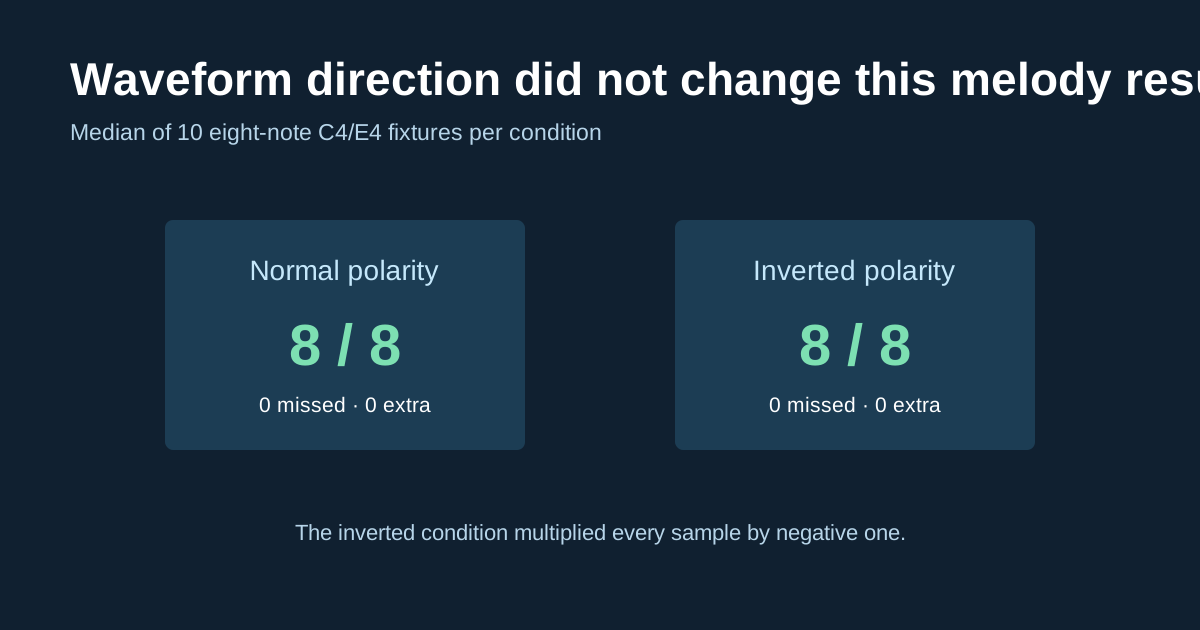
Controlled polarity check
| Waveform direction | Median across 10 fixtures |
|---|---|
| Normal polarity | 8 retained; 0 missed; 0 extra |
| Fully inverted polarity | 8 retained; 0 missed; 0 extra |
When polarity can still matter
Polarity can matter when channels or microphones are combined, because opposite waveforms can cancel each other. That is not what this one-channel inversion check tested. This result only says that flipping the complete mono waveform did not alter this pitch result.
Fixture conditions and limits
Each condition used 10 mono 44.1 kHz synthetic PCM fixtures with eight
alternating C4/E4 voice-like harmonic notes, 120 ms per note, 0.70
source amplitude, and an 8 ms fade. Melody / solo instrument mode,
Balanced sensitivity, a 2048-sample analysis window, and a 1024-sample
hop stayed fixed. Retained means exactly one output overlaps at least
50% and is within 50 cents. Detector SHA-256:
DDA185AC8FB6A179A4FCFA73FD4197ACC95B8B6F59B233F5D3E330F596309F9F.
These are controlled source checks, not a universal polarity, phase, mix, or accuracy promise.