Does electrical hum affect MIDI conversion?
In this controlled eight-note check, a 120 Hz hum created a median extra event at 0.03 amplitude. At 0.12, half the intended notes were missed.
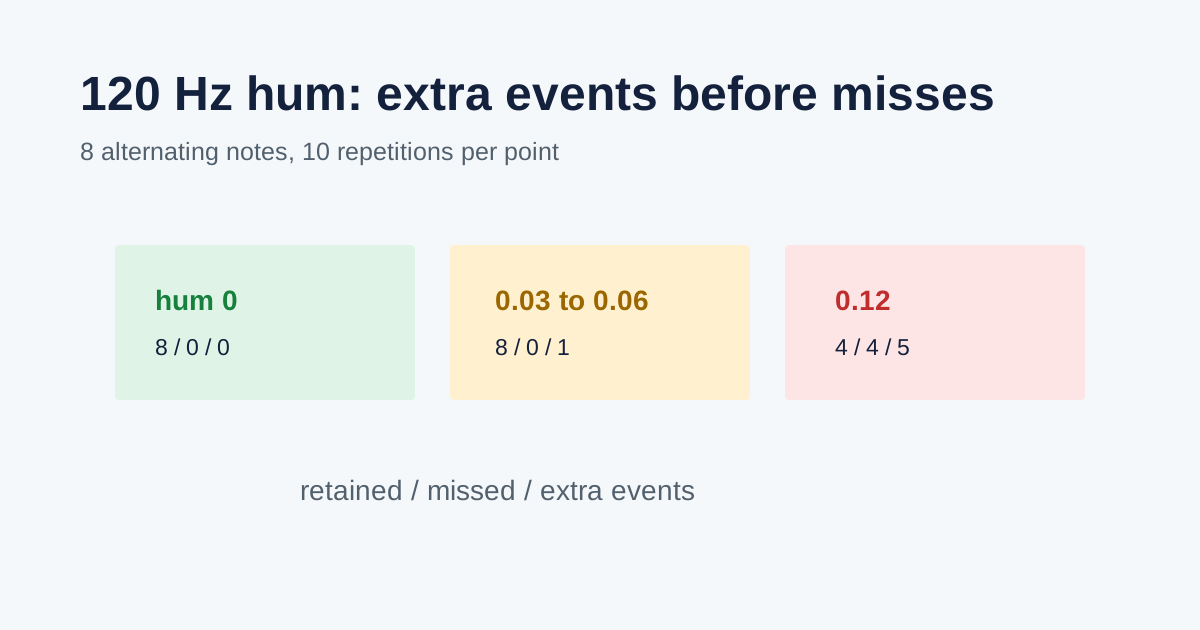
Controlled 120 Hz hum check
| Added 120 Hz hum amplitude | Median across 10 fixtures |
|---|---|
| 0 | 8 retained; 0 missed; 0 extra |
| 0.03, 0.06 | 8 retained; 0 missed; 1 extra |
| 0.12 | 4 retained; 4 missed; 5 extra |
| 0.24 | 0 retained; 8 missed; 9 extra |
Fixture conditions and limits
Each point used 10 mono 44.1 kHz fixtures with eight alternating C4/E4 synthetic voice-like harmonic notes, 120 ms per note, amplitude 0.70, and an 8 ms fade. Only the stated 120 Hz hum plus a 240 Hz harmonic changed. Melody / solo instrument mode, Balanced sensitivity, a 2048-sample analysis window, and a 1024-sample hop stayed fixed. Retained means exactly one output within 50 cents and at least 50% overlap; unmatched output is extra. Detector SHA-256: DDA185AC8FB6A179A4FCFA73FD4197ACC95B8B6F59B233F5D3E330F596309F9F.
These are controlled source checks, not a universal electrical-noise or accuracy promise.