Does a fast attack make MIDI notes disappear?
Not by itself in this clean sustained C4 fixture. From an 8 ms to a 240 ms attack, every tested point retained one event across 10 repetitions. Do not slow every attack before checking the source for noise or competing pitches.
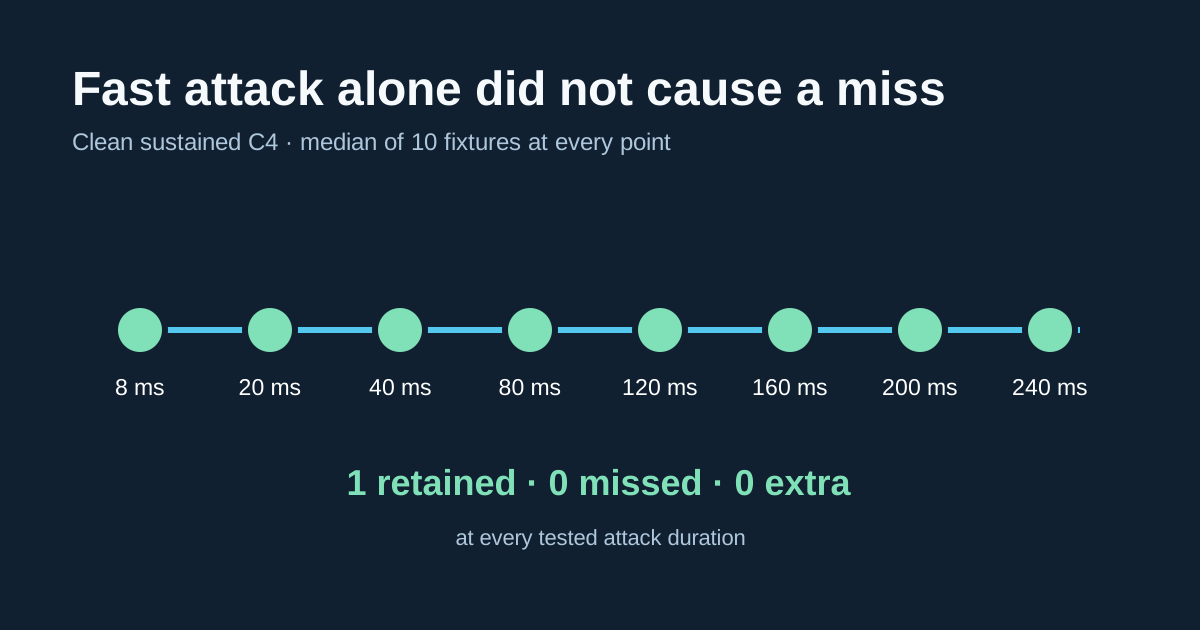
Controlled attack check
| Declared sustained C4 attack | Median across 10 fixtures | Result |
|---|---|---|
| 8, 20, 40, 80 ms | 1 retained; 0 missed; 0 extra | One event appeared. |
| 120, 160, 200, 240 ms | 1 retained; 0 missed; 0 extra | One event appeared. |
Fast attack is not the same as a noisy onset
This check changes attack duration only. It does not contradict the no-stable-pitch check, where added noise changed the outcome. A fast, clean onset and a noisy onset are different source conditions.
Fixture conditions and limits
Each point used 10 generated mono 44.1 kHz 16-bit PCM WAV fixtures and a
clean sustained C4 source. The detector used Balanced Melody / solo
instrument mode, a 2048-sample analysis window, and a 1024-sample hop. A
match needed at least 50% overlap and a pitch within 50 cents of C4.
Detector SHA-256:
DDA185AC8FB6A179A4FCFA73FD4197ACC95B8B6F59B233F5D3E330F596309F9F.
These are controlled source checks, not a universal onset threshold or accuracy promise.