Why short notes disappear in audio to MIDI
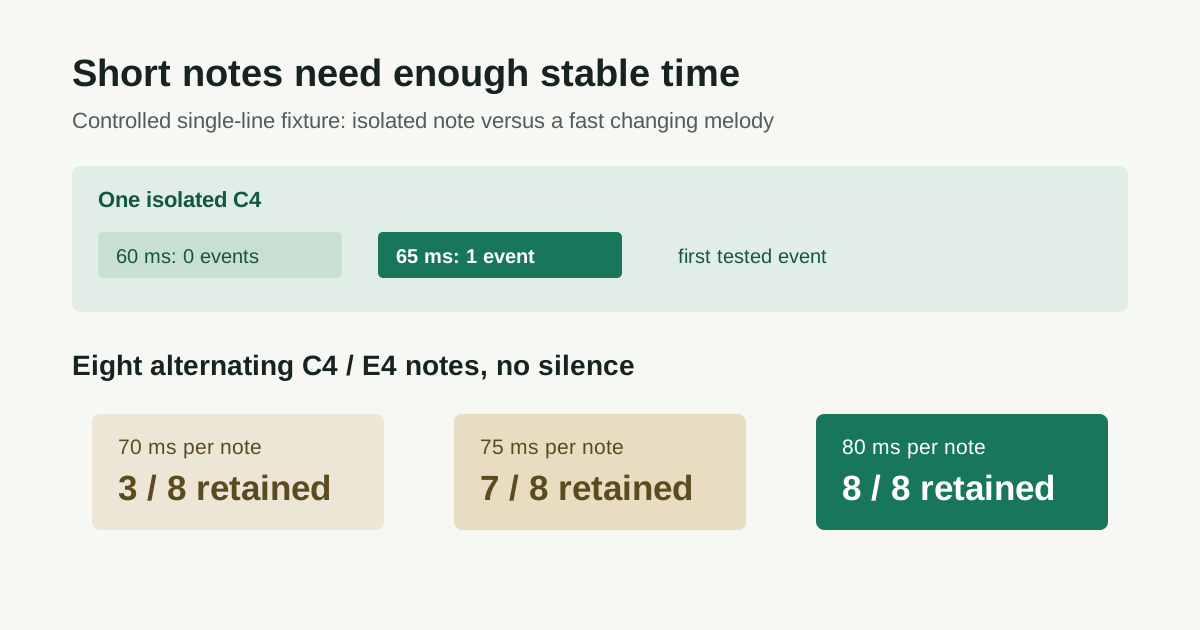
Short notes need enough stable audio to become MIDI events. In this controlled fixture, one isolated C4 first produced an event at the first tested 65 ms; for eight alternating notes, 80 ms per note was the first fully retained sequence.
Two short-note checks, not one threshold
One short isolated sound is easier to identify than a string of rapidly changing notes. Treating them as one cutoff hides the question that matters when you edit: did the tool miss a brief attack, or did a fast melody not leave enough stable time for each note to resolve?
| Controlled source | Median result across 10 fixtures | What the result says |
|---|---|---|
| One isolated C4, 60 ms | 0 events | This tested duration did not produce an event. |
| One isolated C4, 65 ms | 1 event | This was the first tested isolated-note duration that produced an event. |
| Eight alternating C4 / E4 notes, no silence, 70 ms per note | 3 of 8 retained events | Most fast changes were not retained in this fixture. |
| Eight alternating C4 / E4 notes, no silence, 75 ms per note | 7 retained, 1 missed, 1 extra | The phrase was close, but not a clean eight-event result. |
| Eight alternating C4 / E4 notes, no silence, 80 ms per note | 8 retained, 0 missed, 0 extra | This was the first fully retained tested sequence. |
Make the repair decision from the source
- Confirm the intended attack. Listen to the missing moment at normal speed and again in a short loop. A real attack, syllable, pluck, or bow change is evidence; a vague transient is not.
- Keep the scope small. If the overall contour is right and one confirmed short note is absent, add or adjust that one event in your MIDI editor.
- Do not invent a rhythm grid. When the output merges several fast notes or follows another part, choose a clearer phrase or slow the source phrase before retrying. Redrawing an entire unverified run is not conversion.
- Check the first pause. A missing pause often reveals a merged event more reliably than judging a tiny pitch difference alone.
Why faster melodies need more time
The detector does not receive a label saying where one note ends and the next begins. It reads overlapping analysis windows from the signal. A 65 ms isolated sound can be enough to form one event in this setup, while a changing phrase must establish both pitch regions and their boundary. That is why the isolated and alternating results should stay as separate rows rather than being collapsed into one advertised number.
Fixture conditions and limits
Every parameter point used 10 generated mono WAV fixtures with the same declared pitch, amplitude envelope, 44.1 kHz sample rate, and detector settings. The fixtures used documented initial-phase presets so frame alignment was exercised without changing the tested duration. A valid input note occupied its target pitch region for at least 50 ms. A retained event overlapped the matching input by at least 50% and stayed within 50 cents. A miss had no matching output; an extra event was unmatched, or a second output event matched the same input.
Detector settings were Balanced Melody / solo instrument mode, a 2048-sample analysis window, and a 1024-sample hop. Detector source SHA-256: DDA185AC8FB6A179A4FCFA73FD4197ACC95B8B6F59B233F5D3E330F596309F9F.
These are controlled source checks, not a general voice, instrument, complete-song, stem-separation, chord-transcription, or universal accuracy claim. Quote the conditions with the figures; without them, the figures become an unsupported promise.
Questions about missing short MIDI notes
Should I always make the source slower?
No. Use a slower or clearer phrase when you need an editable sketch and the original fast sequence is not retained. Keep the original source when its performance detail matters more than a simplified MIDI sketch.
Why did one short note work but a fast run fail?
An isolated note needs one stable pitch region. A fast run needs each pitch region plus separations between adjacent notes. The controlled results above measure those jobs separately.
Can this recover every staccato note from a whole song?
No. Start with one exposed melody line. This tool does not separate stems, transcribe chords, or reconstruct a finished multitrack arrangement from a complete mix.