Can a noise gate cut MIDI notes?
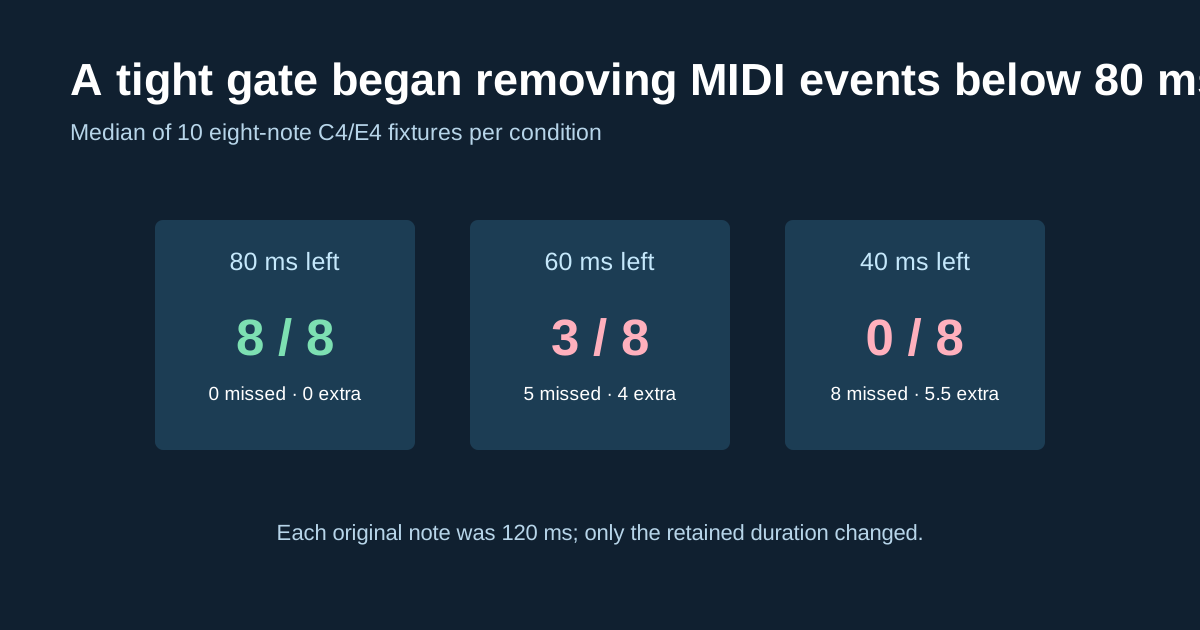
Yes in this controlled eight-note fixture. Leaving 80 ms or more of each 120 ms note retained all eight notes; cutting each note to 60 ms produced a median five misses and four extra events.
Controlled gate-duration check
| Time left from each 120 ms note | Median across 10 fixtures |
|---|---|
| 120, 100, 80 ms | 8 retained; 0 missed; 0 extra |
| 60 ms | 3 retained; 5 missed; 4 extra |
| 40 ms | 0 retained; 8 missed; 5.5 extra |
Why a gate can look like a pitch problem
The gate did not add another pitch. It simply replaced the later part of each declared note with silence. At 60 ms, some events disappeared while the remaining detections also left unmatched outputs. Check note length before moving notes around in the piano roll.
Fixture conditions and limits
Each point used 10 mono 44.1 kHz synthetic PCM fixtures with eight alternating C4/E4 voice-like harmonic notes, originally 120 ms per note, at 0.70 source amplitude. Only the post-gate duration changed. Melody / solo instrument mode, Balanced sensitivity, a 2048-sample analysis window, and a 1024-sample hop stayed fixed. Retained means exactly one output overlaps at least 50% and is within 50 cents. Detector SHA-256: DDA185AC8FB6A179A4FCFA73FD4197ACC95B8B6F59B233F5D3E330F596309F9F.
These are controlled source checks, not a universal gate, instrument, song, or accuracy promise.