Do repeated audio notes merge into one MIDI note?
Yes in this controlled repeated-C4 fixture. Two 160 ms C4 notes with 0, 10, or 20 ms between them produced one merged MIDI event; from a 40 ms gap onward, they separated into two events.
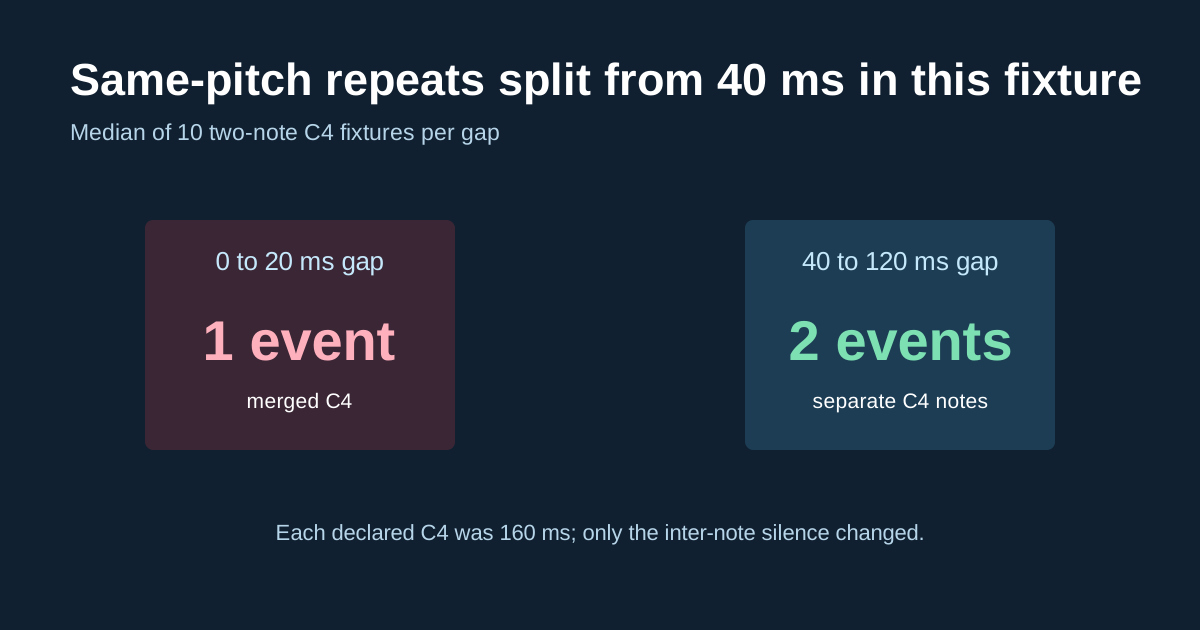
Controlled repeated-note check
| Silence between two 160 ms C4 notes | Median across 10 fixtures | Result |
|---|---|---|
| 0, 10, 20 ms | 1 output; 1 of 2 source notes separately retained | One merged C4 event. |
| 40, 60, 80, 120 ms | 2 outputs; 2 of 2 source notes separately retained | Two C4 events remained. |
Why this differs from changing notes
A C4 followed by E4 gives the detector a pitch change to mark a new event. Two C4 notes do not. The nearby changing-note gap check found C4 then E4 separate even with no gap; this test isolates the extra separation same-pitch repeats need in this fixture.
Fixture conditions and limits
Each point used 10 mono 44.1 kHz synthetic PCM fixtures with two identical C4 voice-like harmonic notes, 160 ms per note, 0.70 source amplitude, and an 8 ms fade. Only the silent gap changed. Melody / solo instrument mode, Balanced sensitivity, a 2048-sample analysis window, and a 1024-sample hop stayed fixed. A note was separately retained when a distinct C4 output overlapped at least 50% of its declared region without reusing an output. Detector SHA-256: DDA185AC8FB6A179A4FCFA73FD4197ACC95B8B6F59B233F5D3E330F596309F9F.
These are controlled source checks, not a universal repeated-note, instrument, song, or accuracy promise.