How does detuned audio map to MIDI notes?
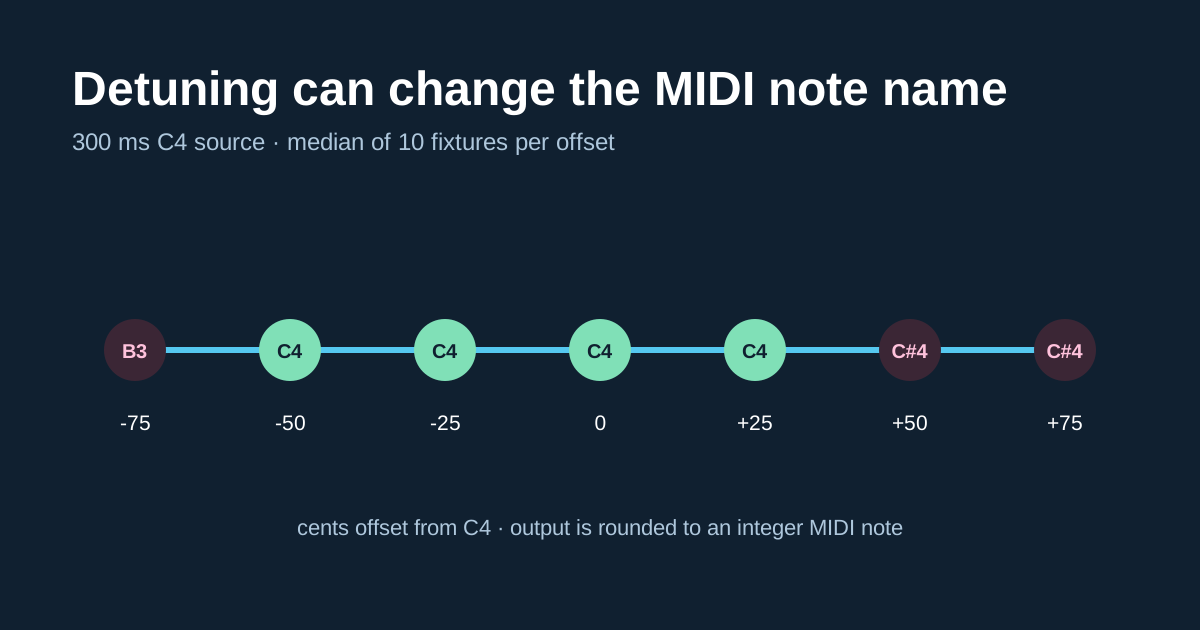
The output is rounded to an integer MIDI note. In this controlled C4 check, -50 through +25 cents still mapped to C4; -75 cents mapped to B3, while +50 and +75 cents mapped to C#4.
Controlled detuning check
| 300 ms C4 offset | Median output MIDI note | Result |
|---|---|---|
| -75 cents | B3 | Not retained as C4 |
| -50, -25, 0, +25 cents | C4 | Retained as C4 |
| +50 and +75 cents | C#4 | Not retained as C4 |
Rounded notes are not tuning correction
The browser writes integer MIDI notes. It does not preserve a cents offset as continuous pitch data. Treat a neighboring output note as a signal to check the source tuning, not proof of a second note in the performance.
Fixture conditions and limits
Each point used 10 generated mono 44.1 kHz fixtures with a synthetic 300 ms C4 source at amplitude 0.70, Melody / solo instrument mode, Balanced sensitivity, a 2048-sample analysis window, and a 1024-sample hop. A retained C4 needed one output at C4 with at least 50% overlap. Detector SHA-256: DDA185AC8FB6A179A4FCFA73FD4197ACC95B8B6F59B233F5D3E330F596309F9F.
These are controlled source checks, not a universal tuning, voice, instrument, song, or accuracy promise.