Why slow pitch drift creates extra MIDI notes
A single held note that slowly wanders in pitch can split into extra MIDI events. In this controlled fixture, the first tested split appeared at 0.125 Hz; that is slow drift, not vibrato.
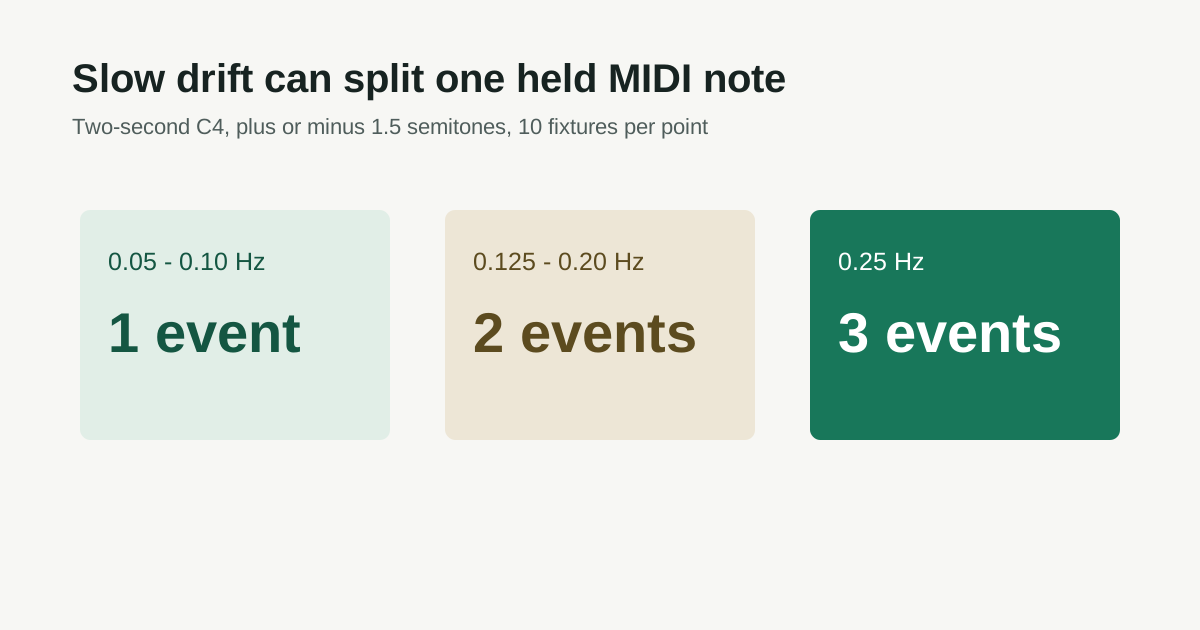
Controlled drift check
| Two-second C4, plus or minus 1.5 semitones | Median across 10 fixtures | Interpretation |
|---|---|---|
| 0.05, 0.075, 0.10 Hz | 1 retained event; 0 extras | One event remained. |
| 0.125, 0.15, 0.20 Hz | 2 events; 1 retained; 1 extra | First tested splitting range. |
| 0.25 Hz | 3 events; 0 retained; 1 missed; 3 extras | The original one-event reading no longer held. |
Do not call drift vibrato
Vibrato and drift are separate axes. The vibrato fixture on this site tests 5 to 7 Hz movement; this page tests 0.05 to 0.25 Hz. A number from one test does not describe the other.
Fixture conditions and limits
Each point used 10 generated mono 44.1 kHz 16-bit PCM WAV fixtures, a
synthetic voice-like harmonic source, Balanced Melody / solo instrument
mode, a 2048-sample analysis window, and a 1024-sample hop. A match
needed at least 50% overlap and 50 cents of the declared trajectory.
Detector SHA-256:
DDA185AC8FB6A179A4FCFA73FD4197ACC95B8B6F59B233F5D3E330F596309F9F.
These are controlled source checks, not a general voice, instrument, song, chord, stem-separation, or accuracy promise.