Why a pitch slide becomes several MIDI notes
A slide is continuous, but MIDI note events are discrete. In this controlled one-second C4 upward scan, one semitone produced one event; wider slides produced progressively more events.
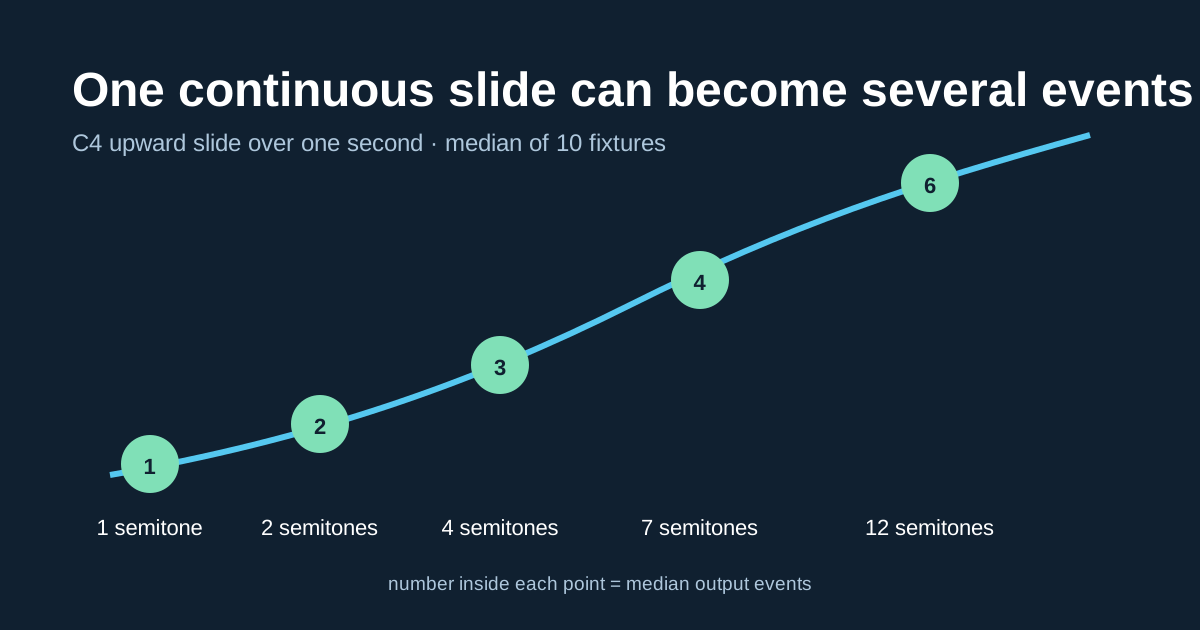
Controlled upward-slide check
| One-second slide from C4 | Median output events across 10 fixtures | Reading |
|---|---|---|
| Up 1 semitone | 1 | One event |
| Up 2 or 3 semitones | 2 | First tested split |
| Up 4 or 5 semitones | 3 | More than one event |
| Up 7 semitones | 4 | Further fragmentation |
| Up 12 semitones | 6 | Six events from one slide |
Slide, drift, and vibrato are separate checks
This page changes slide distance over one second. Slow pitch drift changes rate over two seconds; vibrato changes both depth and 5 to 7 Hz rate. Do not quote one axis as though it measured another.
Fixture conditions and limits
Each point used 10 generated mono 44.1 kHz 16-bit PCM WAV fixtures with a synthetic voice-like harmonic source, Balanced Melody / solo instrument mode, a 2048-sample analysis window, and a 1024-sample hop. The result reported here is output-event count, because a continuous glide has no declared discrete note boundaries. Detector SHA-256: DDA185AC8FB6A179A4FCFA73FD4197ACC95B8B6F59B233F5D3E330F596309F9F.
These are controlled source checks, not a general voice, instrument, song, chord, stem-separation, or accuracy promise.