Does a missing fundamental cause wrong MIDI notes?
Not in this controlled eight-note harmonic fixture. Reducing the fundamental from full level to zero kept all eight expected notes, with no median misses, extra events, or octave-up outputs.
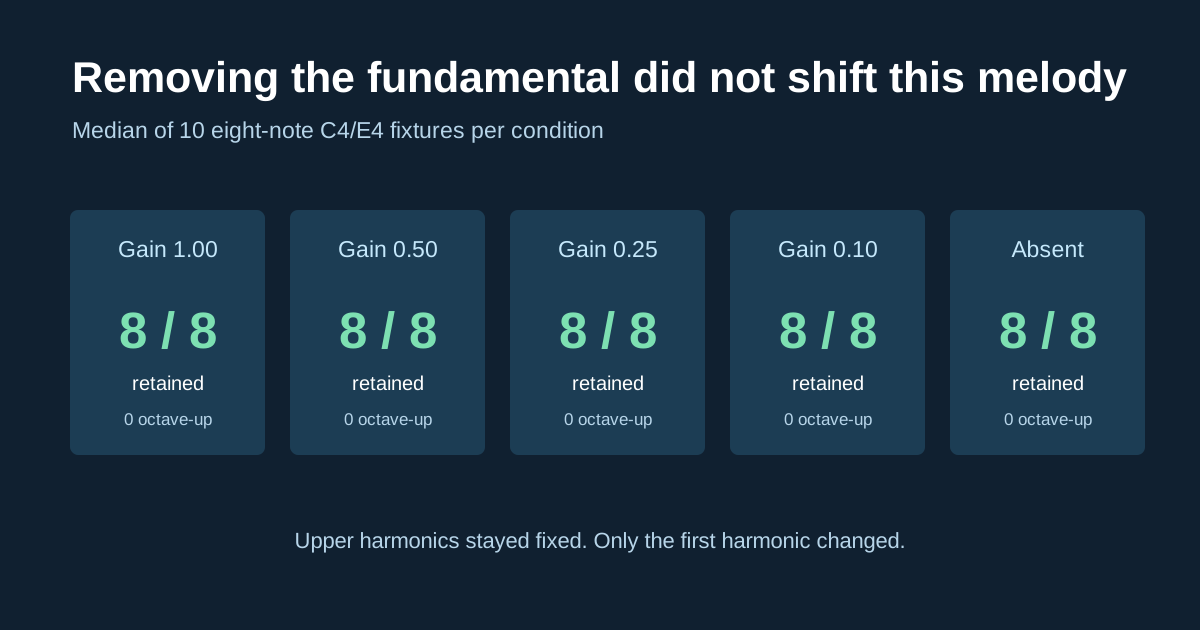
Controlled missing-fundamental check
| Fundamental gain | Median across 10 fixtures | Octave-up outputs |
|---|---|---|
| 1.00, 0.50, 0.25 | 8 retained; 0 missed; 0 extra | 0 |
| 0.10 | 8 retained; 0 missed; 0 extra | 0 |
| 0.00 (absent) | 8 retained; 0 missed; 0 extra | 0 |
What was actually removed
The test signal alternated C4 and E4 every 120 ms. Its second, third, and fourth harmonics stayed fixed while the first harmonic was reduced through five declared gains. The final condition contains only those upper harmonics. The pitch target remained the declared C4 or E4, so an overlapping output exactly 12 semitones higher was counted separately as an octave-up event.
What this result does not settle
A real recording can also contain competing instruments, room reflections, noise, a pitch slide, or a non-harmonic attack. Those conditions were not added here. If a result follows a different part or lands in the wrong octave, isolate a shorter and clearer phrase before treating the missing fundamental as the cause.
Fixture conditions and limits
Each point used 10 mono 44.1 kHz synthetic PCM fixtures with eight alternating C4/E4 harmonic notes, 120 ms per note, and 0.70 output amplitude. The fixed second, third, and fourth harmonic gains were 0.62, 0.36, and 0.20. Melody / solo instrument mode, Balanced sensitivity, a 2048-sample analysis window, and a 1024-sample hop stayed fixed. Retained means exactly one output overlaps at least 50% and is within 50 cents. Detector SHA-256: DDA185AC8FB6A179A4FCFA73FD4197ACC95B8B6F59B233F5D3E330F596309F9F.
These are controlled source checks, not a universal harmonic-content or accuracy promise.