Does octave doubling affect MIDI conversion?
Not for the base melody in this controlled fixture. Eight alternating C4/E4 notes remained 8 of 8 when a simultaneous upper octave was added at 25%, 50%, or 100% of the base amplitude.
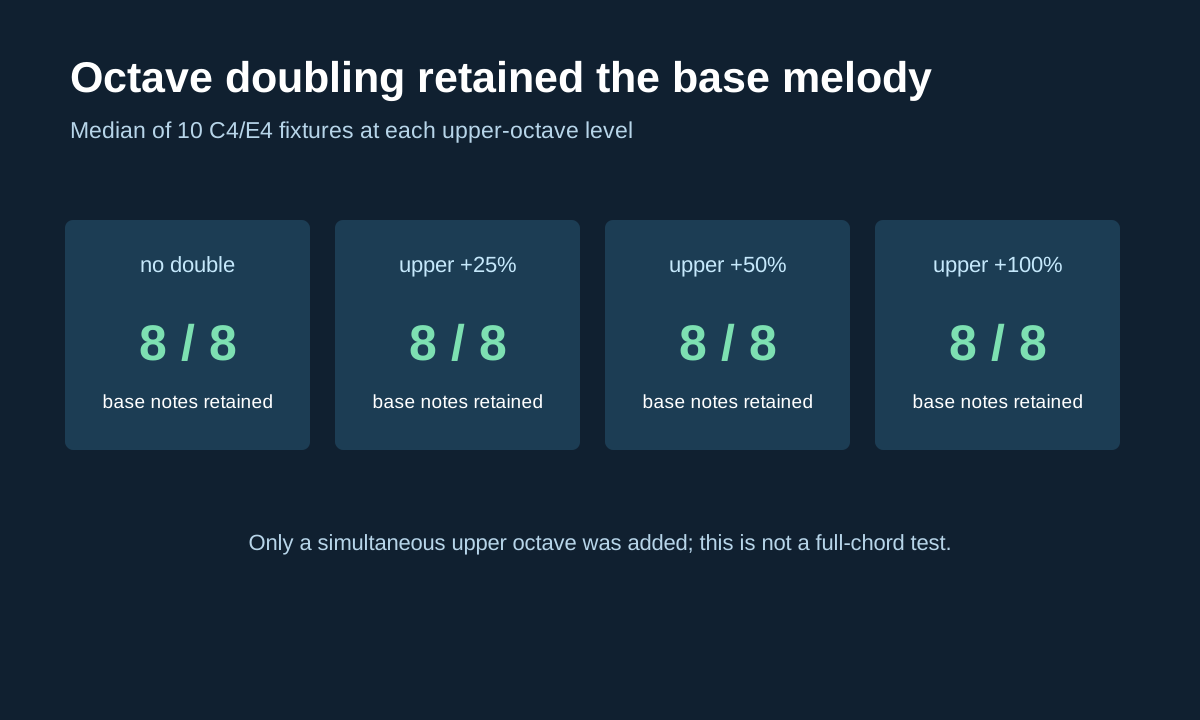
Controlled octave-double check
| Upper octave relative amplitude | Median across 10 fixtures | Base melody result |
|---|---|---|
| None; 25%; 50% | 8 retained; 0 missed; 0 extra | All eight C4/E4 base notes remained. |
| 100%, equal to the base amplitude | 8 retained; 0 missed; 0 extra | All eight C4/E4 base notes remained. |
Why this is narrower than a chord test
Both voices move together at an exact octave. That preserves one timing pattern and a strong harmonic relationship. A chord adds independently moving pitch choices, which is a different input problem. See why dense simultaneous content is harder before using this result to judge a full arrangement.
Fixture conditions and limits
Each point used 10 mono 44.1 kHz synthetic PCM fixtures with eight alternating C4/E4 voice-like harmonic notes, 120 ms per note, at 0.70 base amplitude and 8 ms fades. A simultaneous upper octave was added at the stated relative amplitude. Melody / solo instrument mode, Balanced sensitivity, a 2048-sample analysis window, and a 1024-sample hop stayed fixed. Retained means one output overlapped at least 50% of a declared base note and had its declared MIDI value. Detector SHA-256: DDA185AC8FB6A179A4FCFA73FD4197ACC95B8B6F59B233F5D3E330F596309F9F.
These are controlled source checks, not a universal octave, harmony, instrument, song, or accuracy promise.