Does audio sample rate affect MIDI conversion?
It did for this controlled fast-note fixture. At 22.05 kHz, an eight-note 100 ms-per-note melody retained zero events; at 32, 44.1, and 48 kHz, it retained all 8.
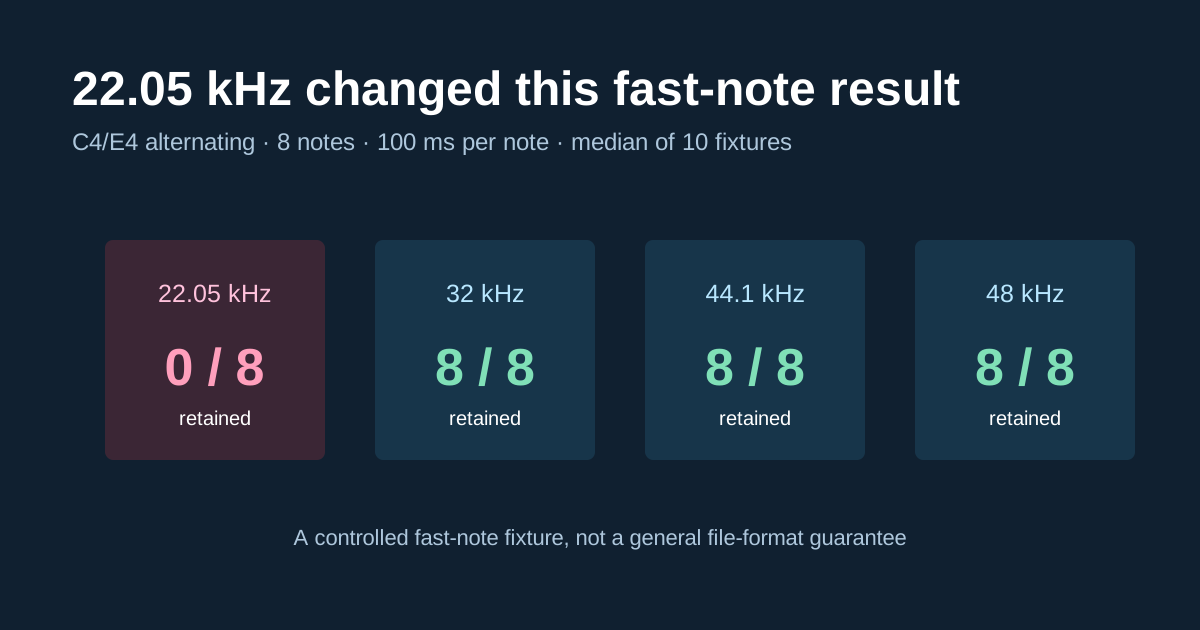
Controlled sample-rate check
| 8 alternating C4/E4 notes, 100 ms each | Median across 10 fixtures | Result |
|---|---|---|
| 22.05 kHz | 0 retained; 8 missed; 0 extra | No matching events. |
| 32 kHz | 8 retained; 0 missed; 0 extra | All notes retained. |
| 44.1 kHz | 8 retained; 0 missed; 0 extra | All notes retained. |
| 48 kHz | 8 retained; 0 missed; 0 extra | All notes retained. |
Do not turn this into a format guarantee
This result does not say every 22.05 kHz file fails, nor that a higher sample rate fixes chords, noise, or a full mix. It says sample rate changed this particular fast, clear, one-line test. Source complexity remains a separate limit.
Fixture conditions and limits
Each rate used 10 generated mono PCM WAV fixtures with the same
synthetic voice-like harmonic source, alternating C4/E4 notes with no
gap, Melody / solo instrument mode, Balanced sensitivity, a 2048-sample
analysis window, and a 1024-sample hop. A retained note required exactly
one output within 50 cents and with at least 50% overlap. Detector
SHA-256:
DDA185AC8FB6A179A4FCFA73FD4197ACC95B8B6F59B233F5D3E330F596309F9F.
These are controlled source checks, not a universal sample-rate, codec, song, voice, instrument, or accuracy promise.