Why does audio to MIDI choose the wrong octave?
In this controlled six-note check, the high C6/E6 source and a C4/E4 source with a simultaneous C5 competitor each produced a median of three octave-down outputs. Removing the C4/E4 fundamental did not.
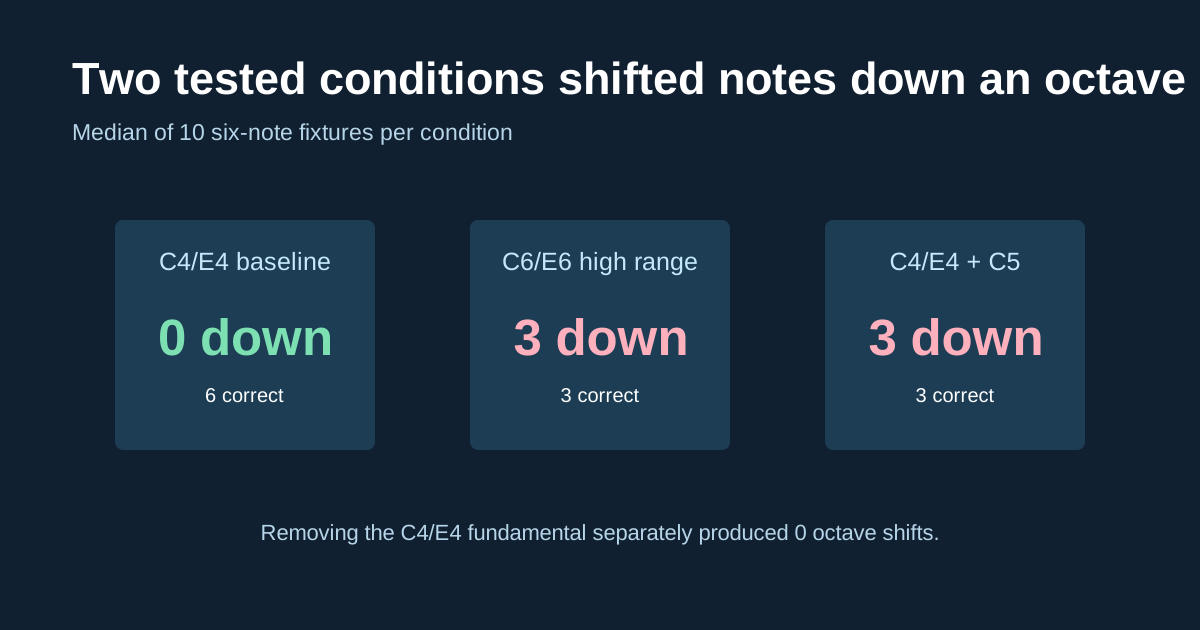
Controlled wrong-octave check
| Condition | Median across 10 fixtures | Octave result |
|---|---|---|
| C4/E4 normal harmonic profile | 6 correct; 0 other | 0 up; 0 down |
| C2/E2 normal harmonic profile | 0 events; 6 without a matching event | No octave event |
| C6/E6 normal harmonic profile | 3 correct; 3 extra | 3 down |
| C4/E4 without fundamental | 6 correct; 0 other | 0 up; 0 down |
| C4/E4 plus simultaneous C5 | 3 correct; 3 extra | 3 down |
Read the result as a diagnosis, not a guarantee
The source alternated two target pitches for six 160 ms notes. The high range and competitor conditions each caused a median of three events one octave below the declared target. The low C2/E2 test did not produce a usable event, which is a different failure from an octave shift. This test does not show that every high note or every added pitch will fail.
Try these checks before editing
- Shorten the source: leave one exposed melodic line rather than two pitches at the same time.
- Check the note range: compare a high phrase against a nearby lower phrase before moving every MIDI event by an octave.
- Keep the source beside the piano roll: correct only notes that you can confirm by listening to the matching moment.
Fixture conditions and limits
Each condition used 10 mono 44.1 kHz synthetic PCM fixtures, six alternating notes at 160 ms each, and 10 initial phases. The normal target had fundamental through fourth-harmonic gains of 1.00, 0.42, 0.20, and 0.08. The missing-fundamental condition used 0, 0.62, 0.36, and 0.20. The competitor condition added a simultaneous C5 at gain 0.65. Melody / solo instrument mode, Balanced sensitivity, a 2048-sample analysis window, and a 1024-sample hop stayed fixed. An octave-down result was an overlapping output exactly 12 semitones below the declared target. Detector SHA-256: DDA185AC8FB6A179A4FCFA73FD4197ACC95B8B6F59B233F5D3E330F596309F9F.
These are controlled source checks, not a universal octave, instrument, song, or accuracy promise.